1. Overview
UATG - μArchitectural Test Generator - is an open-source python based framework developed
by InCore to generate RISC-V Assembly tests for functional verification of the RISC-V cores
(currently supports in-house and SHAKTI cores only). While complements of UATG, like
RISCV-CTG , AAPG, etc work at the ISA level and focus on generating
tests to maximize ISA coverage, UATG is more focused on micro-architecture driven tests.
Micro-architectural components like caches, branch predictors, scoreboards, etc which are more
implementation driven and less ISA defined, require a dedicated set of tests to be written to test
them thoroughly.
Also, as InCore is primarily focused on core-generators like Chromite, a significant portion of the micro-architectural features are also heavily parameterized, and creating individual tests for each configuration is not possible. What is required is an equally parameterized set of verification tests for these micro-architectural features.
UATG addresses the above issues, and provides a minimal framework which allows one to create parameterized set of tests which UATG can generate and filter based on the input configuration of the target device. Along with generating tests, UATG also provides hooks to define and generate a parameterized set of coverpoints which can help indicate the health of the test-suite being run on a target.
The parameterized tests in UATG are written as python-plugins which can generate assembly programs. These python programs are required to follow a certain API as outlined by UATG and produce artifacts which UATG can use to generate the final Assembly tests. These python plugins have the capability to generate relevant tests based on the configuration of the target DUT or skip generation completely if certain features in the configuration have been disabled.
Note
that these tests are significantly compatible with the TestFormat Spec outlined here, however do expect minimal divergence from the spec as features of UATG grow.
UATG has ensured that the framework and tests are decoupled and thus the tests themselves can be hosted as a separate directory or repository and can be fed into UATG to generate Assembly tests. You can find examples of python-plugins for some of Chromite’s modules in the chromite-uatg-tests repository
The tests generated using UATG can be run on the DUT in the conventional way or by using a framework like RiVer Core. The UATG plugin for RiVer Core automatically selects the uatg plugin to generate the tests, run it on the DUT, obtain coverage as well as compare the logs from DUT, and reference and finally provide a comprehensive report of your test’s health !
Steps to install and run the tests can be found in the quickstart section of this document. Steps to create tests can be found here in the UATG Framework section.
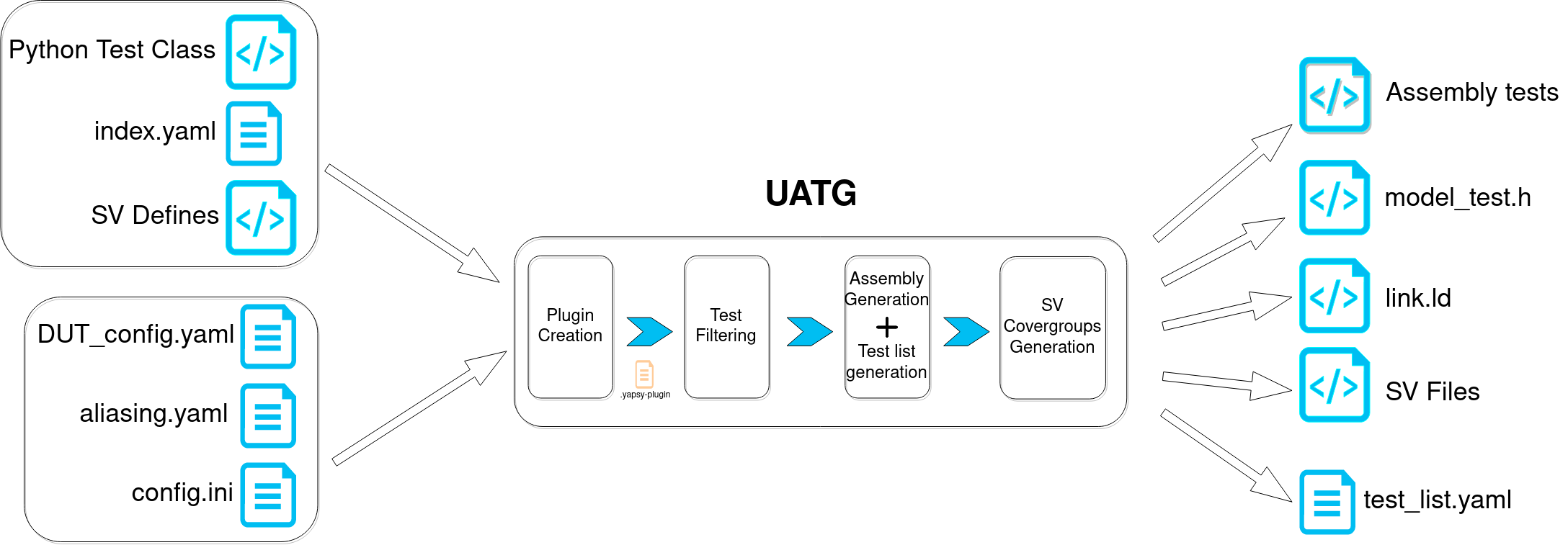
The overall tool flow is shown in the diagram below:
In addition to generating tests, the user can use regular expressions and parse
the logs for finding the coverage of his test. The validate feature of UATG
does this. The flow is shown in the diagram below:
